Table of Contents
ToggleA full-size bedroom with minimal square footage doesn’t have to mean sacrificing storage or style. Storage full beds solve one of the most common challenges in compact homes: where to put seasonal clothes, extra bedding, or bulky items when closet space is limited. Instead of adding dressers or plastic bins that clutter the room, a storage bed integrates concealed compartments directly into the footprint you’re already using. Whether you’re furnishing a guest room, a teenager’s bedroom, or a studio apartment, understanding the design options and structural considerations will help you maximize every inch without compromise.
Key Takeaways
- A storage full bed reclaims 12 to 25 cubic feet of usable space beneath the mattress, solving storage challenges in compact homes without adding freestanding furniture.
- Drawer storage beds with ball-bearing slides offer smooth, accessible organization for everyday items, while hydraulic lift beds provide large, uninterrupted cavities ideal for bulky, seasonal storage.
- Proper installation and maintenance are critical: gas struts require precise mounting and replacement every 5 to 8 years, and drawer slides should support at least 75 pounds per drawer.
- Before purchasing a storage full bed, measure your room to ensure adequate side clearance for drawer access or sufficient ceiling height for the elevated sleeping surface.
- Choose frames built from solid hardwood, engineered wood with minimum 600 kg/m³ density, or welded steel to ensure weight capacity of 600 to 800 pounds for durability through moves and regular use.
- Platform storage beds work with any mattress type, but memory foam and hybrid mattresses require slatted platforms with gaps no wider than 3 inches to prevent sagging and warranty issues.
What Is a Storage Full Bed and Why You Need One
A storage full bed is a mattress frame designed with built-in compartments, typically drawers, lift-up platforms, or cubbies, beneath the sleeping surface. Full-size beds measure 54 inches wide by 75 inches long, offering a footprint that fits most standard bedrooms while leaving floor space for movement. Adding storage to that footprint turns wasted vertical space into functional capacity.
The average bedroom closet holds 24 to 36 cubic feet of volume, but the space under a standard bed frame often goes unused or becomes a dust collector. A storage full bed reclaims that volume with organized, accessible compartments. Depending on the design, you can gain between 12 and 25 cubic feet of usable storage, enough for off-season wardrobes, extra linens, or hobby supplies.
This solution works especially well in rooms where adding a dresser would block windows, doorways, or walkways. In rental units where built-in closets are minimal or nonexistent, a storage bed reduces the need for freestanding furniture. It’s also a smart choice for kids’ rooms and guest rooms, where toy bins, seasonal gear, or extra pillows need a home without creating visual clutter.
From a structural standpoint, most storage beds use slat support systems or platform bases rather than traditional box springs. This keeps the mattress height manageable while maintaining airflow. When shopping, confirm that the slat spacing doesn’t exceed 3 inches if you’re using a memory foam or hybrid mattress, as wider gaps can void warranties or cause sagging.
Types of Storage Full Beds to Maximize Your Space
Drawer Storage Beds
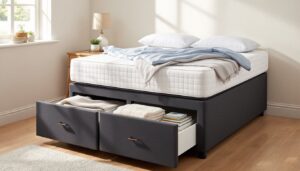
Drawer storage beds feature built-in drawers on one or both sides of the frame, accessible from the room’s perimeter. Most designs include two to six drawers, each ranging from 12 to 18 inches deep. Side-access drawers work best when the bed is centered against a wall or positioned with clearance on at least one side.
Construction quality varies widely. Look for drawers mounted on ball-bearing slides or Euro glides rather than cheap plastic tracks. Ball-bearing hardware supports heavier loads, up to 75 pounds per drawer, and operates smoothly even when fully loaded with folded jeans or sweaters. Cheaper slides can bind, warp, or break within a year of regular use.
Some drawer beds use undermount drawers that sit on the floor rather than being integrated into the frame. These are easier to assemble and often cost less, but they require a smooth, level floor and can scratch hardwood or catch on area rugs. For carpeted rooms, undermount drawers may not glide as smoothly.
Drawer beds suit renters and frequent movers because disassembly is straightforward, most use standard bolts and cam locks. They’re also ideal if you prefer to access storage without lifting the mattress or disrupting bedding. If you’re building a DIY version, resources like Fix This Build That offer detailed woodworking plans for custom drawer units.
Hydraulic Lift Storage Beds
Hydraulic lift beds (also called ottoman beds or gas lift beds) feature a hinged platform that raises to reveal a large, open storage cavity beneath the entire mattress. A gas strut mechanism does the heavy lifting, literally. These struts are rated by force (measured in Newtons), and most full-size beds use struts rated between 800N and 1200N to safely lift a mattress and bedding.
The storage cavity typically offers 15 to 25 cubic feet of uninterrupted space, making it perfect for bulky items like comforters, luggage, or sports equipment. Unlike drawer beds, there are no dividers or compartments, so you’ll need bins or organizers if you want internal structure.
One trade-off: accessing the storage requires clearing everything off the bed. If you need daily access to stored items, a drawer bed is more practical. Hydraulic lift beds shine when storing seasonal or occasional-use items. Many storage bed designs balance aesthetics with lift mechanisms that integrate cleanly into upholstered or wooden frames.
Installation is more involved than drawer beds. The gas struts must be mounted at precise angles and heights to function correctly, misalignment can cause uneven lifting or early strut failure. If you’re assembling one, follow torque specs for all bolts and test the lift mechanism before adding the mattress. Always use lifting straps and a helper during assembly: these frames are heavy, and pinch points are common.
Safety note: Gas struts lose pressure over time. Expect to replace them every 5 to 8 years depending on use frequency. Replacement struts are inexpensive (typically $20 to $40 per pair) and widely available online with measurements in millimeters (stroke length and extended length).
How to Choose the Right Storage Full Bed for Your Room
Start by measuring your bedroom with a 25-foot tape measure. Note the distance from the wall to any obstructions, doors, windows, radiators, or outlets. A full bed requires at least 54 inches of width, but you’ll want an additional 24 to 36 inches on the sides for drawer clearance or ease of making the bed. If your room is less than 10 feet wide, a hydraulic lift bed may be a better fit since it doesn’t require side access.
Next, consider ceiling height and mattress thickness. Storage beds elevate the sleeping surface by 12 to 18 inches compared to a standard frame on legs. Add a 10- to 14-inch mattress, and you’re sitting at 22 to 32 inches total. If your ceilings are the standard 8 feet (96 inches), this won’t be an issue. In older homes with 7-foot ceilings, test the height with a mock-up to ensure it doesn’t feel cramped.
Material and weight capacity matter, especially if two adults will share the bed. Look for frames built from solid hardwood, engineered wood with a minimum density of 600 kg/m³, or welded steel. Particle board and MDF are common in budget models but sag under sustained weight and can’t handle re-tightening of bolts after a move. Check the manufacturer’s static weight rating, it should support at least 600 to 800 pounds for a full-size bed (mattress plus two adults).
For renters, prioritize disassembly. Beds that use cam lock fasteners and Allen bolts break down in under an hour and transport more easily than glued or nailed construction. For custom builds, The Handyman’s Daughter offers beginner-friendly plans that use pocket screws and standard pine or plywood.
Finally, think about mattress compatibility. Platform storage beds work with any mattress type, but if you prefer a box spring, you’ll need a design with a reinforced center support beam and slats spaced appropriately. Memory foam and latex mattresses require good airflow to prevent moisture buildup, look for slatted platforms with gaps no wider than 3 inches and consider adding a breathable mattress protector.
Don’t overlook assembly complexity. Budget an extra 1 to 2 hours beyond the manufacturer’s estimate, especially for hydraulic lift models. Gather a Phillips screwdriver, Allen wrench set, rubber mallet, and level before you start. Work on a clean, flat surface, and double-check that all hardware is accounted for before tightening anything permanently.
Conclusion
A storage full bed transforms unused vertical space into organized, accessible capacity without expanding the room’s footprint. Whether you choose drawer-style access or a hydraulic lift platform, focus on build quality, weight ratings, and how the design fits your daily routines. Measure carefully, plan for assembly time, and prioritize materials that will last through moves and heavy use.