Table of Contents
ToggleSpace is the currency of modern living, and a storage loft bed banks it in every square foot. These elevated platforms do more than lift a mattress, they reclaim floor area otherwise swallowed by bulky dressers, nightstands, and underbed plastic bins. Whether outfitting a studio apartment, a kid’s bedroom, or a home office that moonlights as a guest room, a properly designed loft bed turns vertical space into organized, functional storage. This guide walks through types, selection criteria, a full DIY build, and finishing touches to maximize every inch below the mattress.
Key Takeaways
- A storage loft bed elevates your sleeping surface 4–6 feet high, reclaiming 20–30 square feet of floor space by replacing separate dressers, desks, and nightstands with unified storage.
- Verify your ceiling height meets IRC code: minimum 7 feet for an 8-inch mattress on a 4-foot platform with required 30 inches of clearance above the mattress.
- Choose between drawer-integrated, cabinet-style, or open-shelf loft bed designs based on your priority—whether it’s clothing storage, hiding off-season items, or quick-access organization.
- A DIY storage loft bed build requires proper framing with 4×4 posts and 2×6 joists, wall-mounted ledger boards with lag bolts, and reinforced desk cleats screwed into wall studs for stability.
- Install guardrails at least 36 inches above the mattress with gaps no wider than 3.5 inches, and opt for stairs over ladders if accessibility for children or older adults is a concern.
- Maximize your storage loft bed’s visual appeal and functionality by adding LED lighting, fabric bins with labels, a low-pile rug below, and committing to weekly organization maintenance.
What Is a Storage Loft Bed and Why You Need One
A storage loft bed elevates a sleeping surface on a raised frame, typically four to six feet off the floor, creating usable space underneath. That void accommodates drawers, cabinets, desks, shelving, or a combination of all four. Unlike a standard bed frame with shallow underbed bins, a loft bed unlocks the full vertical clearance, often delivering 30 to 50 cubic feet of storage or workspace.
The value proposition is straightforward: eliminate redundant furniture. A twin-size loft bed with built-in dresser and desk can replace three separate pieces, freeing 20 to 30 square feet of floor space. For bedrooms under 100 square feet, that’s a game-changer. In children’s rooms, the extra space becomes a play zone: in adult studios, it transforms into a home office or walk-in closet.
Structurally, loft beds require solid engineering. The frame must support not just the mattress and sleeper, 500 to 800 pounds total dynamic load, but also the weight of stored items below. Most residential designs use 2×6 or 2×8 lumber for the main support beams and 4×4 posts for the legs. Metal pipe frames offer a lighter aesthetic but demand careful welding or industrial-grade flanges to prevent racking.
Before committing, check ceiling height. The International Residential Code (IRC) requires a minimum 30 inches of clearance above the mattress surface. For an eight-inch mattress on a four-foot-high platform, that means a seven-foot ceiling minimum. Most homes clear this, but older bungalows and attic bedrooms sometimes don’t.
Types of Storage Loft Beds for Every Room
Built-In Drawer and Cabinet Designs
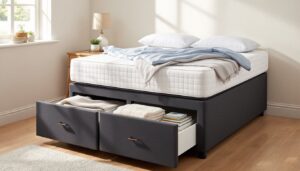
Drawer-integrated loft beds position a chest of drawers or full dresser directly beneath the sleeping platform. The stair side often doubles as a cascading set of storage steps, each riser containing a pull-out drawer. This configuration suits kids’ rooms and teen bedrooms where clothing storage is the priority.
Look for full-extension ball-bearing drawer slides rated for 75 to 100 pounds. Cheaper side-mount slides sag and jam under the weight of folded jeans and sweatshirts. For maximum capacity, organizing bedroom clutter can complement the loft bed with overhead or wall-mounted solutions.
Cabinet-style lofts replace open drawers with hinged doors and adjustable shelves. This design works well for adult studios, hiding linens, off-season gear, or office supplies. Piano hinges or concealed European hinges prevent door sag. Add a keyed cam lock if storing valuables.
Some manufacturers offer modular units where drawer banks and cabinets can be rearranged or swapped out. This flexibility is valuable as needs evolve, swapping a dresser module for a mini-fridge cabinet in a college dorm, for example.
Open Shelving and Desk Combinations
Open-shelf lofts sacrifice privacy for accessibility. Cubbies and horizontal shelves below the bed provide quick-grab storage for books, bins, and decor. This layout pairs well with a built-in desk, creating a compact bedroom-office combo.
Desktop height should sit 28 to 30 inches off the floor for ergonomic typing and writing. Ensure the loft platform doesn’t restrict headroom when seated: a four-foot-high loft leaves 48 inches at the desk, comfortable for most adults. Taller users may need a five-foot platform or a standing desk converter.
Integrate cable management grommets in the desktop and a power strip mount on the frame upright. Nothing kills the clean look faster than a tangle of charging cables.
For heavy computer setups, reinforce the desktop with a cleat screwed into wall studs. A floating desk cantilevered from the loft frame alone will bounce under typing, annoying and unprofessional during video calls. Free plans from Ana White often include desk-loft combos with full cut lists and hardware specs.
How to Choose the Right Storage Loft Bed
Start with mattress size. Twin and twin XL lofts fit single sleepers: full-size platforms accommodate couples or sprawling solo sleepers. Queen loft beds exist but demand 6×6 posts and a reinforced joist system, plan for a much heavier, more complex build.
Measure the room. A standard twin loft bed occupies roughly 80 inches long by 42 inches wide, plus the footprint of stairs or a ladder. Corner configurations save space, but confirm door swing clearance and allow 24 to 30 inches around the bed for changing sheets.
Ladder versus stairs: ladders are compact and cheap but tough for small kids, older adults, or anyone hauling a glass of water at midnight. Staircase lofts consume more floor space, typically 36 inches wide by 48 inches deep, but they’re safer and can incorporate those valuable storage steps. If building a staircase, follow IRC stair code: maximum 7.75-inch rise, minimum 10-inch tread depth, and a graspable handrail.
Material choice affects cost and aesthetics. Solid pine or fir runs $150 to $300 in lumber for a twin loft, stains easily, and handles joinery well. Birch plywood and hardwood edging deliver a modern look but add expense. Metal pipe frames (using 1.5-inch black iron pipe or Kee Klamp fittings) skew industrial: they’re lighter but require threading dies or pre-threaded components.
Weight capacity matters. Most commercial loft beds rate 250 to 400 pounds for the sleeping surface. If storing heavy items below, file cabinets, a loaded bookcase, verify the floor can handle the combined load. For compact storage strategies, distributing weight across the loft’s footprint helps.
Finally, consider ventilation and lighting. An enclosed loft bed with cabinet walls underneath can trap heat and feel claustrophobic. Add a small fan or leave gaps between cabinet backs and the wall. Install an LED strip or swing-arm lamp inside the sleeping area: overhead fixtures cast shadows, making bedtime reading miserable.
DIY Storage Loft Bed: Step-by-Step Building Guide
Tools & Materials:
- Circular saw or miter saw
- Drill/driver with bits and countersink
- Level (4-foot), tape measure, speed square
- Lumber: Four 4×4×8 posts, six 2×6×8 joists, two 2×6×10 ledgers, ¾-inch plywood for decking
- Hardware: 3-inch construction screws, ½×4-inch lag bolts with washers, joist hangers, wood glue
- PPE: Safety glasses, hearing protection, dust mask
Step 1: Plan and Mark
Measure twice. Sketch the footprint on the floor with painter’s tape. Mark stud locations on walls where ledger boards will attach. For a freestanding loft, skip wall attachment but add diagonal bracing between posts.
Check the ceiling for obstructions, ceiling fans, light fixtures, smoke detectors. Relocate or lower the platform height if needed.
Step 2: Cut and Assemble Frame
Cut four 4×4 posts to final height (typically 60 to 72 inches for a five-foot sleeping surface). Cut six 2×6 joists to span the width (usually 42 inches for a twin). Cut two 2×6 ledgers to run the length (80 inches for a twin).
Attach ledgers to wall studs using ½×4-inch lag bolts every 16 inches. If building freestanding, skip this step and join ledgers to the posts with construction screws and wood glue.
Connect joists to ledgers using galvanized joist hangers or by face-screwing through the ledger into joist ends. Space joists 16 inches on center. The outer two joists sit flush with the ends of the ledger.
Step 3: Install Posts and Deck
Stand the four posts at the front corners (if wall-mounted) or all four corners (if freestanding). Clamp each post plumb, then secure to the joist frame with four 3-inch screws per joint, driven at angles. Add a second ledger across the front, connecting the post tops.
Cut ¾-inch plywood to cover the joist frame, leaving a 1-inch overhang on the front and sides for a finished edge. Screw down every 8 inches along each joist. For a quieter platform, apply construction adhesive before screwing.
Step 4: Add Storage Components
This is where customization happens. For streamlined storage, build simple drawer boxes using ½-inch plywood for sides and ¼-inch plywood backs. Dado joints at the corners add strength: pocket screws work if you lack a router.
Mount drawer slides to the underside of the platform joists. Pre-drill all screw holes to prevent splitting. If installing shelves, use adjustable shelf pins in ¼-inch holes drilled every 2 inches.
For a built-in desk, cantilever a 24-inch-deep plywood top from the loft frame and secure a cleat to wall studs for the back edge. Plans from The Handyman’s Daughter offer detailed desk-mount options.
Step 5: Build Stairs or Ladder
A simple ladder uses two 2×3 rails and 1-inch dowel rungs spaced 12 inches apart. Drill 1-inch holes 1 inch deep into the rails, glue dowels, then screw the rail tops to the loft frame.
For stairs, cut stringers from 2×12 lumber using a framing square to lay out 7-inch rise and 10-inch run. Attach treads (¾-inch plywood or solid 1×10 boards) with construction screws. Install a handrail at 34 to 38 inches above the tread nosing.
Step 6: Sand, Finish, and Safety Check
Sand all exposed edges to 120 grit. Apply primer and two coats of satin or semi-gloss paint, or use polyurethane over stain for a natural look. Let cure fully, 72 hours minimum, before placing the mattress.
Add a guardrail on any open side of the sleeping platform. IRC requires rails at least 36 inches above the mattress surface with gaps no wider than 3.5 inches to prevent child entrapment. Secure rails with lag bolts, not just screws.
Load-test the bed. Have an adult (or two) climb up and shift weight. Listen for creaks or movement. Tighten any loose fasteners. Detailed building guides from Fix This Build That include load-testing protocols and fastener torque specs.
Styling and Maximizing Your Storage Loft Bed Space
Finish work separates a plywood box from a bedroom centerpiece. Paint the frame in a color that contrasts or complements the walls, deep navy, charcoal gray, or classic white are safe bets. For a modern look, leave metal pipe frames bare or seal with clear matte lacquer to prevent rust.
Use fabric bins or woven baskets in open cubbies to hide clutter. Label each bin with a tag or chalkboard label for easy identification. This is especially useful in kids’ rooms where toy chaos reigns.
Maximize lighting. Stick-on LED puck lights or a battery-powered motion sensor strip inside the loft provide ambient light without wiring. For the desk area below, a clamp-on task lamp or a swing-arm wall mount offers focused illumination.
Textiles soften the structure. Drape a curtain rod across the front of the loft to create a cozy sleeping nook or hide storage below. Use blackout fabric in bedrooms where morning sun is an issue.
For versatile organization, pegboard panels mounted on the loft’s side posts provide tool-free adjustability. Hang hooks, small shelves, or baskets that can be repositioned as needs change.
Don’t neglect the underbed floor. If the area below becomes a desk or play space, add a low-pile area rug to define the zone and reduce echo. Hard floors under a loft can amplify every movement above.
Finally, keep it tidy. A loft bed’s visual impact depends on what’s visible below. Commit to a weekly five-minute sweep: close drawers, straighten bins, and clear the desktop. The elevated design puts everything on display, make it count.